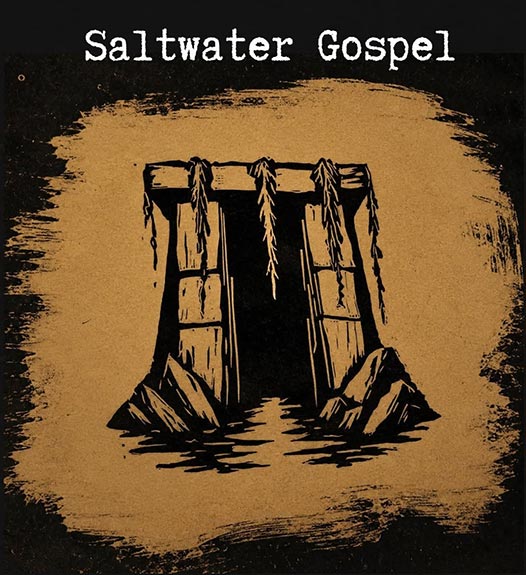
EP: “Saltwater Gospel” by JP Oldfield

Six chapters of dark maritime folklore, mortality and redemption
Wiltshire-based independent singer-songwriter JP Oldfield has recently released Saltwater Gospel, a six-part concept mini-album that plunges headfirst into the murky waters of Southern Gothic, Dark Americana and Dark Folk. This is no ordinary collection of songs, but an ambitious, self-contained world of maritime mythology, where ghosts, sinners, religious hypocrisy and the darker realities of human existence collide.
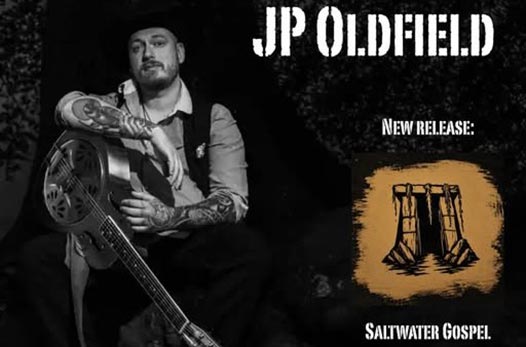
Armed with a naturally deep baritone voice, a resonator guitar and a distinctive suitcase bass drum, Oldfield creates a raw, atmospheric sound that places storytelling firmly at its heart. Drawing inspiration from the likes of Nick Cave, Tom Waits, Johnny Cash and Colter Wall, his music explores the uncomfortable spaces between life and death, faith and corruption, grief and acceptance.
Entirely self-taught, Oldfield approaches the guitar with an inventive combination of hybrid picking and unusual tunings, extracting an extraordinary range of textures from a single instrument. His music is deliberately unpolished, atmospheric and steeped in character, with every element serving a greater purpose.
With Saltwater Gospel, Oldfield has taken this approach several steps further, creating a six-part maritime mythology told through music, traditional linocut artwork and an accompanying written narrative. The result is a project that challenges the conventional boundaries of an EP, inviting the listener into a dark and unsettling tale that unfolds across multiple creative forms.

A FERRYMAN CAUGHT BETWEEN WORLDS
At the centre of Saltwater Gospel is a Ferryman trapped between life and death after refusing to surrender the body of his dead wife to the land. What begins as an act of love and desperation gradually descends into something far more sinister, as grief gives way to vengeance and the desire to control forces that lie beyond human understanding.
Drawing inspiration from dark maritime folklore, epic storytelling and works such as *The Rime of the Ancient Mariner*, Oldfield takes his protagonist on a journey through loss, religious hypocrisy, guilt, catastrophe and, ultimately, acceptance.
Religion weaves its way through the narrative in the form of churches, priests, crosses and scripture, yet faith remains an unsettling and ambiguous presence. Oldfield questions the distinction between genuine belief and the institutions that can use religion as a means of power, forgiveness and control.
As the mythology unfolds, the Ferryman’s personal tragedy becomes something much greater. An angel buried beneath the desert represents an inconvenient warning that humanity refuses to acknowledge. The faithful condemn it as blasphemy, sceptics dismiss it as madness, while opportunists see another chance to exploit the situation.
Humanity buries the warning. Then comes the flood.
Both a literal catastrophe and a powerful metaphor, the deluge represents the natural world reclaiming what mankind mistakenly believes it owns. Throughout the story, the sea becomes more than a setting; it is an ancient, relentless force that outlives generations and ultimately reclaims everything humanity attempts to bury or forget.
At the heart of this mythology lies one simple but ominous idea: the sea remembers.
A STORY ROOTED IN MORTALITY
While the Ferryman’s tale is fictional, the themes underpinning Saltwater Gospel are rooted in Oldfield’s own confrontation with mortality.
At just 29, Oldfield was diagnosed with cancer. Following his recovery, the experience fundamentally changed his outlook on life and led him to a realisation that would eventually reshape his musical journey: life is too short not to pursue the things you genuinely want to do.
A lifelong guitarist, Oldfield had never sung publicly and had never set out to become the frontman of a project like this. Unable to find local musicians who shared the musical vision taking shape in his head, he took a chance and attended an open mic alone.
One open mic became another, song writing followed, and gradually an entirely new musical identity emerged. Moving away from his earlier metal background, Oldfield found himself exploring blues, folk, Americana, dark country and narrative-driven song writing.
There is a striking parallel between the artist and his Ferryman. Both are confronted by mortality, both must face the limits of their own control, and both discover that life rarely follows the course we believe we have chosen.
For Oldfield, that personal journey has helped shape a body of work that feels far more than an exercise in dark storytelling. There is genuine human experience beneath the mythology, giving the songs an emotional weight that reaches beyond their fictional world.
## ONE MAN, ONE GUITAR, A WORLD OF SOUND
Oldfield’s musical approach is as distinctive as the stories he tells. At its core is the metallic, raw character of a resonator guitar, drawing on the traditions of Delta blues and early roots music. A bass drum built into a suitcase provides the rhythmic heartbeat, creating a stripped-back arrangement that feels both primitive and powerfully atmospheric.
Rather than relying on a conventional full-band setup, Oldfield uses hybrid picking, unusual tunings and his self-taught technique to coax as much harmonic, rhythmic and textural detail as possible from a single guitar.
His naturally deep baritone becomes another instrument in the mix: weathered, low and deliberately unpolished, perfectly suited to the shadowy landscapes he creates. This is not music designed around conventional vocal expectations or polished production. Its strength lies in its character, atmosphere and ability to draw the listener into another world.
Across Saltwater Gospel, three different guitar tunings help establish a distinct atmosphere for each chapter, while maintaining the feeling of a continuous musical journey. Blues, folk, progressive elements, Dark Americana and heavier influences all find their place, creating a sound that refuses to be neatly confined to a single genre.
The stripped-back instrumentation also leaves plenty of room for the storytelling. Every note, beat and vocal inflection contributes to the atmosphere, allowing the songs to breathe while gradually drawing the listener deeper into the Ferryman’s troubled world.
SURRENDERING TO THE CURRENT
The conclusion of Saltwater Gospel offers no straightforward victory, triumphant salvation or satisfying revenge. Instead, the Ferryman eventually comes to understand that the land never wronged him. His greatest mistake was believing he had the right to determine what should happen to life, death and those around him.
His final act is one of surrender.
It is a fitting resolution for a story so deeply concerned with grief, control and the human inability to accept the inevitable. The Ferryman must finally relinquish the very thing he has spent the entire story fighting to hold on to.
The ending is deliberately cyclical. Humanity rebuilds, the flood becomes legend, and the world begins again. The tragedy is absorbed into history, its warnings gradually forgotten, leaving the door open for the same mistakes to be repeated.
This brings us back to the title, Saltwater Gospel. The sea has its own scripture, but it does not preach through words. Its lessons are delivered through repetition: ebb and flow, loss and renewal, death and rebirth.
The sea remembers everything, even when humanity chooses not to.
MORE THAN A MINI-ALBUM
What makes Saltwater Gospel particularly compelling is the sheer scope of Oldfield’s vision. The music is only one part of the experience, accompanied by artwork he has created himself using traditional linocut techniques and a written narrative that expands the mythology beyond the songs.
Every element has been independently conceived and created by Oldfield, resulting in a unified creative world in which sound, imagery and storytelling work together.
As Oldfield explains: “I wanted to see how far an EP could be pushed as a medium. The music is one part of the story, while the artwork and written narrative provide other ways into the world of the Ferryman.”
It is an ambitious undertaking for any artist, let alone an independent musician working outside the conventional music industry. Rather than chasing trends, algorithms or neatly defined genre expectations, Oldfield has followed his own creative instincts, building something personal, unconventional and unapologetically dark.
Following his debut EP Bouffon and subsequent single No Rest, Saltwater Gospel marks another significant step in the evolution of JP Oldfield’s sound and song writing.
There is something refreshing about an artist willing to trust his own imagination and take a concept this far. This is music that asks for more than a casual listen; it invites you to step inside its world, explore its mythology and consider the uncomfortable truths lurking beneath its surface.
Dark, atmospheric and steeped in maritime folklore, Saltwater Gospel is a compelling example of independent creativity at its most ambitious. JP Oldfield has not simply written six songs; he has created a world shaped by loss, mortality and the consequences of refusing to let go.
And somewhere beneath those dark, unforgiving waters, the sea continues to remember.
Track-Listing
It’s Just Begun
The Preacher’s Noose
Wash Me Away
Further From Heaven
Heavy Was The Rain
No Rest
Saltwater Gospel is Out Now and be purchased here.
Link
https://www.facebook.com/profile.php?id=61590766466727
https://www.youtube.com/@JPOldfield_Music